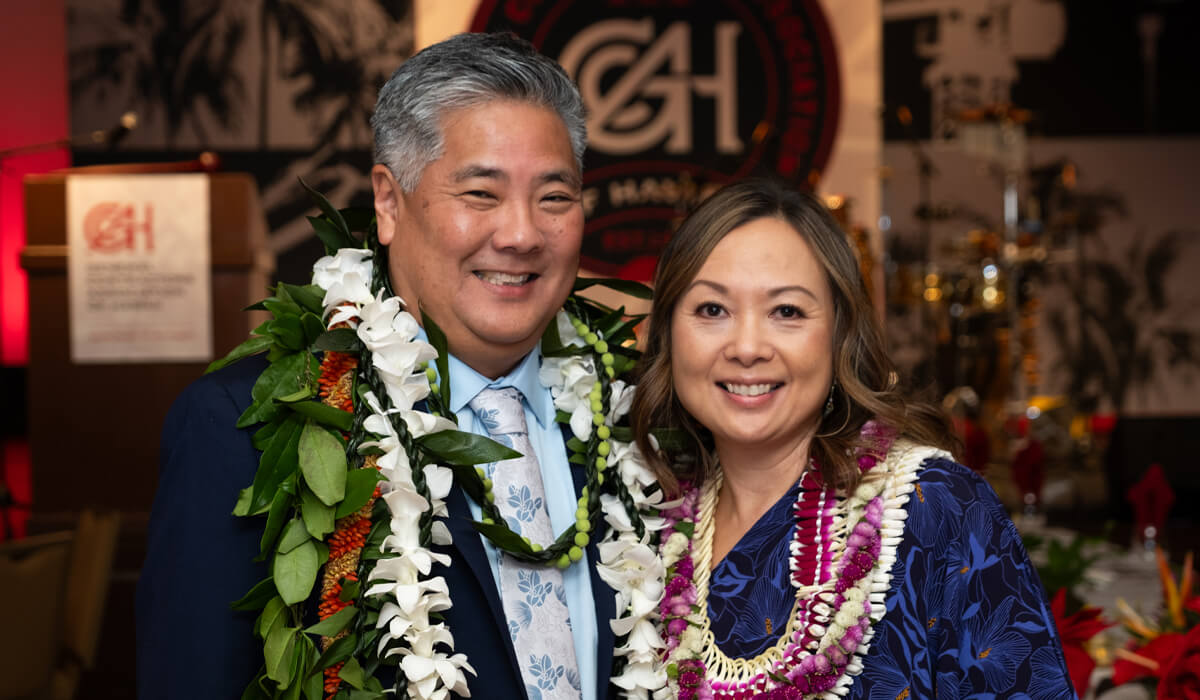
Michael Inouye and his wife, Vincy, at the 2026 GCA Installation Ceremony.
A Builder at Heart
GCA of Hawaii President Michael Inouye on Legacy, People, and Progress
By Jeanie J. Clapp
As he begins his term as president of the General Contractors Association of Hawaii, Michael Inouye reflects on family legacy, workforce development, mental health, and what it takes to sustain a proud building culture in a rapidly changing industry.
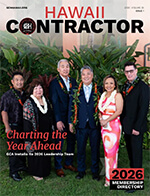
This article appeared in the Hawaii Contractor magazine, 2026, volume 25, issue 1.
Read the digital version here.
If you would like to be added to the mailing list for the next issue, please fill out this form.
Born and raised in Hawaii and steeped in construction from an early age, Michael Inouye brings both technical expertise and deep personal perspective to his role as president of the General Contractors Association of Hawaii (GCA). A professional engineer and vice president of preconstruction services at Ralph S. Inouye Co., Ltd., Inouye represents the third generation from his company to serve as GCA president. As the industry navigates workforce shortages, rapid technological change, and growing awareness around mental health, Inouye is focused on strengthening relationships, developing the next generation of builders and preserving the values that have long defined Hawaii’s construction community.
Q: Tell us a little about yourself and what led you to construction.
Inouye: I was born and raised in Hawaii and grew up around the construction industry. I remember watching my dad leave the house early in the morning and return late in the evening, and the dedication he showed to his work made a lasting impression on me.
I attended Washington University in St. Louis, where I earned a degree in civil engineering and a master’s degree in construction management.
After completing my education, I returned home and worked as a design engineer for Calvin Kim and Associates, earned my professional engineer license, and then joined Ralph S. Inouye Co., Ltd. in 1999. Ralph Inouye, our founder, is my great uncle. Lance Inouye, his son, is our chairman of the board, and my father was VP of operations here for a long time. Blake Inouye, our current president, is my second cousin, and I currently serve as vice president of preconstruction services.
My wife, Vincy, and I have two daughters who are both in college. Our oldest, Taylor, is a junior at the University of Washington and a member of the women’s rowing team. Our younger daughter, Emi, is a freshman at Saint Louis University and an accomplished dancer. Watching them pursue their own paths has been incredibly rewarding and grounding for me, and they continue to be a source of inspiration.
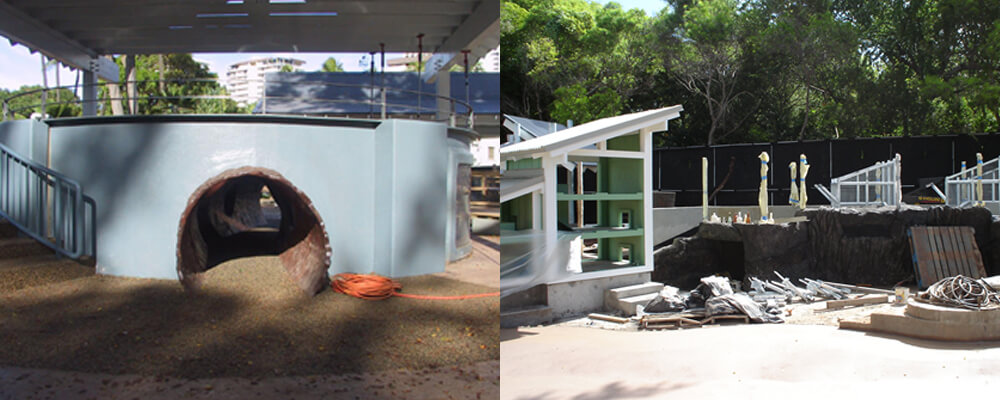
Construction on the Keiki area at the Honolulu Zoo: (Left) Fiberglass Koi Tank with fiberglass log crawl-thru, (Right) guinea pig hutch to left, Crawl and pop-up center.
Q: What do you love about this industry?
One of my favorite construction projects was completing the Keiki Zoo at the Honolulu Zoo. My kids were young when it opened, and seeing their excitement — knowing their dad helped build something like that — made it especially meaningful. That will always hold a special place for me.
I also love watching veteran contractors walk into a building. They instinctively look around, and you can almost see the gears turning — how it was built, what challenges had to be overcome. It makes me reflect on the depth of knowledge they carry and whether I’ll ever reach that level of experience. But regardless of scale, there’s real satisfaction in seeing something come together. Whether it’s a landmark project or something as simple as replacing an HVAC system, construction offers the reward of building something that matters. That sense of accomplishment is what makes this demanding profession enjoyable — and why I know I’m exactly where I’m supposed to be.
Q: What has it been like working in a family business?
Early on, my father was my immediate supervisor, and I was concerned about how the dynamic might work. His generation was more driven — working dawn to dusk — and families had more traditional roles. My generation seeks more of a work-life balance so from the beginning I wondered if there would be friction. What helped was having worked elsewhere first. It gave me confidence and perspective so I could contribute professionally, not just as a family member.
The bigger challenge actually came later when working with relatives in leadership roles. I sometimes forgot that they were my boss first and family second. I had to learn to communicate the same way I would with any supervisor — respectfully, clearly, and professionally.
There’s also internal pressure. You don’t want anyone to think you’re there because of your last name. A superintendent once told me, “Don’t give anyone a reason to think you’re here for anything other than your work.” That stuck with me. You end up holding yourself to a higher standard, and that’s not necessarily a bad thing. What keeps me motivated is the sense that I’m helping carry on the legacy Ralph started. There’s pride in that, and a passion for doing the work well.

Michael Inouye, wife Vincy (top), and daughters Taylor (bottom left) and Emi.
Q: You’ve spoken about generations prior and the importance of institutional knowledge. How do you see that transferring to the next generation?
Sometimes I look around and realize I’ve become one of the “older guys” in the company. I feel like I have one foot in the previous generation and one foot in the next.
I watched people like Ralph — who worked into his 100s — with an incredible work ethic and commitment. At the same time, younger generations value work life balance, flexibility, and technology in ways that are different from how many of us grew up. How do we reconcile that? Construction is an industry where you still need to physically be present and experience things. There’s no substitute for experience, in my opinion. I’m 27 years in, and there are still things I don’t know, but because I’ve experienced a lot and I’ve put in the time, I have the confidence to attack and solve problems. How do I impart some of that wisdom and help fuel that desire to that next generation? It’s still a question I ponder often.
Technology is an incredible tool, but experience still matters. You can’t fast-forward experience the way you can a YouTube video. There’s no substitute for time in the field — learning how to solve problems and understanding how projects truly come together. Technology should support good judgment, not replace it.
If technology can generate a letter or provide instant answers, the question becomes: What skills are we really developing beyond knowing what to ask? My hope is that younger professionals still want to learn fundamentals — not just rely on technology to shortcut the process. This will allow them to develop passion for the industry, because construction isn’t just a job; it’s a career.
Q: Workforce development continues to be a major issue. What is GCA of Hawaii doing to address it?
Workforce development has been a priority for several years and will continue to be one. GCA of Hawaii (through the GCA Education Foundation) has some good programs in place, and every year we evaluate where the issue stands. We’ve got some passionate young people in our organization that are spearheading the initiative and trying to see what works and what doesn’t.
One example is the BreakingGround 808 program, where we train high school counselors and STEM teachers, partnering them with GCA members.
The high school staff learn about different construction roles — through a classroom session led by estimators, project managers, and schedulers — and participate in an activity that provides them with a lesson plan to take back to their classrooms. The activity can be anything from a Lego build to an estimating practice, but the goal is to spark interest early and show students the variety of career paths available in construction.
We’re also working at the college level, providing scholarships and funding a professor position at the University of Hawaii College of Engineering, and supporting the General Contractors Association of Hawaii Construction Management Graduate program at Hawaii Pacific University to assist with pathways to a professional career in our industry.
Retention is just as important as recruitment. It’s about helping people find purpose and passion in the industry — not just a paycheck.
The GCA Education Foundation is a 501c3 nonprofit dedicated to workforce development through initiatives, programs, and support to address the labor shortage in our industry.
Q: When did you first get involved with GCA of Hawaii, and what drew you into leadership?
I started as a committee member in the early 2000s, working on what became the Build Hawaii Awards Committee. That experience introduced me to mentors in the industry and helped me build lasting relationships.
Over time, I stayed involved through committees and board service. When I was asked to step into an executive leadership role a few years ago, the timing felt right both professionally and personally.
I’m honored to be the third representative from Ralph S. Inouye Co. to serve as GCA president. When you see the wall of past presidents, it’s humbling. There are big shoes to fill.
What’s kept me engaged is the relationships — even with competitors. We compete hard in the marketplace, but within the association, there’s mutual respect, a shared commitment to improving the industry, and friendships.
Construction is a demanding profession, and mental health can sometimes be overlooked, particularly in traditionally male-dominated environments. In Hawaii especially, there is often a mindset of powering through challenges — whether physical or emotional — which can make it harder for people to ask for support in a physically demanding field.
Q: What are your priorities for your term as president?
Workforce development remains a top priority. We’ll continue refining what works and expanding effective programs.
Another priority is continuing to deliver meaningful value to our members — whether through training, professional development, or opportunities to build relationships. Our industry is built on relationships, and in-person connections still matter.
A third area of focus is mental health. Construction is a demanding profession, and mental health can sometimes be overlooked, particularly in traditionally male-dominated environments. In Hawaii especially, there is often a mindset of powering through challenges — whether physical or emotional — which can make it harder for people to ask for support in a physically demanding field. While resources do exist, awareness and accessibility remain ongoing challenges.
We want to help member companies better understand what resources exist and how to support their employees. There is help out there, and we want our members to know where to turn. It is not an issue that can be solved in one year, but it’s an important conversation to continue.
Q: What is your outlook for Hawaii’s construction market in the coming year?
Overall, there’s cautious optimism for 2026. Hawaii tends to lag national trends slightly, but there are still significant projects underway — federal work, rail, stadium development, and high-rise construction.
There’s uncertainty around tariffs and global economic conditions, but our industry has proven resilient. Whether it was COVID, material shortages, or supply chain disruptions, contractors have learned how to adapt collaboratively with designers, owners, and suppliers.
Challenges will continue, but I’m confident the industry will find ways to manage them.
Q: If you could change one thing about the construction industry in Hawaii, what would it be?
Rather than changing something outright, my hope is that we continue developing young people with the same spirit that built this industry — hard work, problem-solving, pride, and accountability.
Technology will keep changing how we do business, but the values that define good builders shouldn’t change. I hope future generations carry that same sense of ownership and pride that has long defined Hawaii’s construction community and the GCA.
This article appeared in the Hawaii Contractor magazine, 2026, volume 25, issue 1.
Read the digital version here.
If you would like to be added to the mailing list for the next issue, please fill out this form.